


News
/
Table of contents:
What Is Dihydrotestosterone (DHT)?
How the Dihydrotestosterone Hormone Is Formed
Early Signs of DHT Hair Loss
What Are DHT Blockers
Finasteride as a DHT Blocker (Topical Hair Serum)
Advanced Treatments for Dihydrotestosterone Hair Loss
Hair Transplant Solutions for DHT Resistant Hair
Frequently Asked Questions
Conclusion
Share this article:
Hair loss is not random; it is driven by a combination of genetics and hormonal activity. One of the main causes among these is dihydrotestosterone (DHT), a hormone that can shrink hair follicles and lead to gradual thinning. In people with genetic sensitivity, DHT disrupts the normal hair growth cycle. Over time, this results in a receding hairline, thinning crown, or overall loss of density. This process is known as DHT-related hair loss and can affect both men and women.
Understanding how DHT works is key to choosing the right treatment. Most proven solutions, including DHT blockers and advanced therapies, are designed to target this hormone and slow or prevent further hair loss.
What Is Dihydrotestosterone (DHT)?
Dihydrotestosterone (DHT) is a potent androgen hormone derived from testosterone. It is produced when testosterone is converted by the enzyme 5 alpha reductase into the dihydrotestosterone hormone, which is significantly more active at the cellular level.
It plays a role in male development but can shrink scalp hair follicles in genetically sensitive individuals, leading to progressive hair thinning and pattern hair loss.
DHT is naturally present in the body and contributes to:
- Development of male characteristics during puberty
- Regulation of certain hormonal processes
- Contribution to body hair growth
However, its effect on scalp hair is different. In sensitive individuals, DHT disrupts normal hair growth and leads to thinning.
According to the American Hair Loss Association, over 80% of men experience noticeable hair loss by age 50, largely due to DHT sensitivity. This explains the variation in hair loss patterns across individuals.
How the Dihydrotestosterone Hormone Is Formed
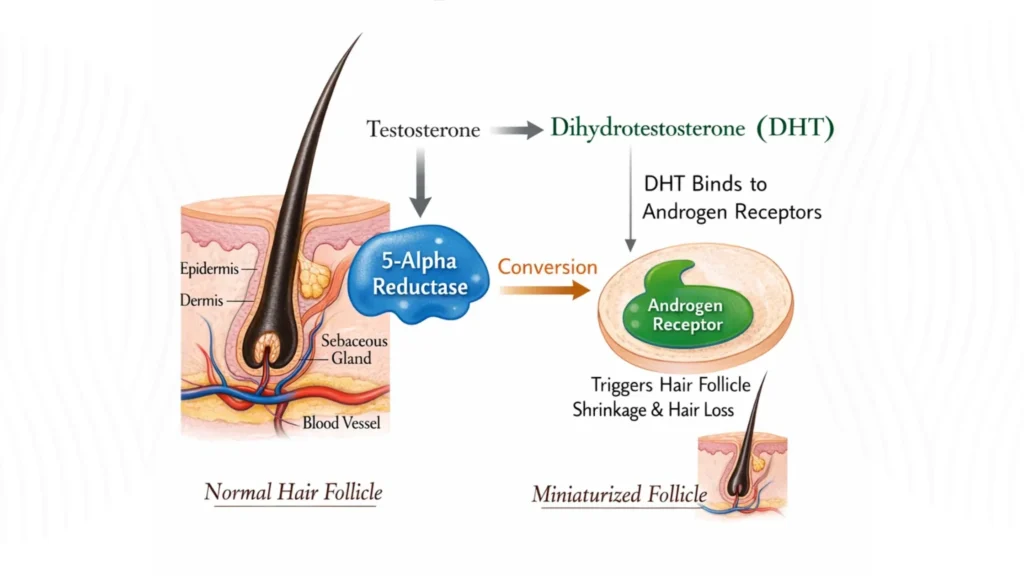
The formation of DHT follows a consistent biological pathway:
- Testosterone circulates throughout the body
- The enzyme 5 alpha reductase converts testosterone
- The result is the dihydrotestosterone hormone (DHT)
This process occurs in tissues such as:
- The scalp
- The skin
- The prostate
In the scalp, elevated DHT levels or increased sensitivity to DHT can accelerate dihydrotestosterone hair loss. This is why many treatment strategies focus on reducing DHT production or limiting its effect on follicles.
Early Signs of DHT Hair Loss

Early detection of dihydrotestosterone hair loss significantly improves treatment outcomes.
Common signs include:
- Gradual recession of the hairline
- Thinning at the crown
- Increased hair shedding
- Reduced overall volume
- Visible scalp through hair
Early stage hair loss is where DHT blockers are most effective.
What Are DHT Blockers
DHT blockers are treatments designed to reduce the production or activity of dihydrotestosterone (DHT).
They function by:
- Inhibiting 5 alpha reductase
- Lowering levels of the dihydrotestosterone hormone
- Preventing DHT from binding to follicles
These treatments are commonly used to slow or stabilize dihydrotestosterone hair loss.
Finasteride as a DHT Blocker (Topical Hair Serum)
Finasteride is one of the most widely prescribed oral DHT blockers as it works by inhibiting the 5-alpha reductase enzyme, thereby reducing dihydrotestosterone levels in the body.
Topical Finasteride is an alternative that delivers localized DHT reduction at the scalp level. It is designed to maintain hair density while minimizing systemic absorption and reducing the likelihood of systemic or sexual side effects. Finasteride is not recommended for men and women trying to conceive.
Topical Finasteride is available by prescription following consultation with the medical team at Clinique de Paris.
Advanced Treatments for Dihydrotestosterone Hair Loss
For moderate to advanced dihydrotestosterone hair loss, additional treatments are often necessary.
Regenerative Treatments
- Platelet based therapies like Platelet Mesotherapy and PMT-X
- Growth factor treatments like Exosomes
Combination Therapy
- DHT blockers like Topical Hair Serums combined with regenerative approaches
- Preventive and corrective treatment plans
These approaches improve follicle health and support sustained hair growth.
Hair Transplant Solutions for DHT Resistant Hair
Hair transplantation offers a long term solution for advanced dihydrotestosterone hair loss.
Direct Hair Implantation uses:
- Donor hair resistant to DHT
- Precision implantation techniques
- Increased growth rate
- Natural-looking result
Transplanted hair retains its resistance to dihydrotestosterone, making results stable and long lasting, which is why transplanted hairs are generally considered permanent.
Frequently Asked Questions
Q1: What is dihydrotestosterone?
Dihydrotestosterone is a hormone derived from testosterone that can bind to hair follicles and contribute to hair thinning in genetically sensitive individuals.
Q2: Does DHT always cause hair loss?
No. Hair loss depends on genetic sensitivity to DHT, not just its presence.
Q3: Is DHT hair loss reversible?
Partially. Early stages can improve, but inactive follicles cannot regrow hair.
Q4: Are DHT blockers effective?
DHT blockers can slow hair loss and help maintain existing hair, particularly in early stages.
Q5: Is DHT hair loss permanent?
Hair loss can become permanent if follicles are no longer active.
Q6: What is the best treatment for DHT hair loss?
Treatment depends on severity and may include DHT blockers, regenerative therapies, or hair transplantation.
Conclusion
Clinique de Paris, approaches dihydrotestosterone hair loss through a structured and personalized method.
Treatment strategies may involve:
- Preventive use of DHT blockers like Topical Hair Serums
- Regenerative therapies like Platelet Mesotherapy, Exosomes, and PMT-X.
- Direct Hair Implantation Hair Transplant
The goal is to deliver natural, consistent, and long term results!
Book a FREE consultation with Clinique de Paris to discover the best solution for your hair loss.
- All Posts
- Media and Articles